
Providing the highest quality pipe organ services to the Atlanta and the Southeast since 2003
Morningside Presbyterian Church
Atlanta, Georgia
Atlanta, Georgia
Robert I. Coulter - Organbuilders
Opus 1 / IV - 49 / 2007
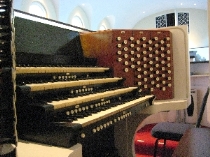
"Morningside's new organ is of the English style, ideally suited for vocal accompaniment. The organ has a rich, warm sound, never lacking in color or power."
Walter Huff Organist/Choirmaster: Morningside Presbyterian Church
Great OrganManual II (CC-c4) / Enclosed with Choir
16' Gemshorn (ext) Swell OrganManual III (CC-c4) / Enclosed
16' Lieblich Gedeckt (ext) Choir OrganManual I (CC-c4) / Enclosed
8' Dolcan |
Antiphonal OrganManual IV (CC-c4) / Enclosed
8' Grand Diapason Pedal OrganEnclosed (CC-g1)
32' Diapason (derived) |
In the fall of 2006, we were contracted by the congregation of Morningside Presbyterian Church to rebuild and enlarge their 1956 Wicks organ. Upon our inspection we found the organ had suffered from extensive water damage in all three chambers (Great/Choir, Swell, and Antiphonal). Additionally, the physical configuration in the Great/Choir chamber was crowded to the point of making proper tuning and service extremely difficult. In this project, in addition to updating the console with modern playing aids and systems, we will be installing all new electro-pneumatic wind chests in the Great/Choir chamber to both allow for better use of space and to provide the opportunity for tonal additions.
In rebuilding the console, we ultimately saved the shell, pedal board and keys. The shell was stripped and totally refinished to match the furnishings of the sanctuary. The pedal board was extensively repaired and refinished as were the keys. All new stop jambs were constructed of a beautiful African Cherry (Makore) and fitted with new Syndyne drawknob units that allow for a graceful feel.
The organ is best described as being Classic American, but not American-Classic! Scales and voicing of ranks is inspired by the work of E.M. Skinner, Kimball and Roosevelt. The Great Diapason chorus based on the First Open has grandness and richness found in large Skinner organs from the 1930's, but with the added clarity and brilliance found in E. & G. G. Hook organs, and rediscovered by later generations. The Second Open is set outside the shades and voiced in a delicate manner to offset the more robust First Open. While the First Open is bold, it speaks with a singing manner and follows our concept of pipes that are properly scaled on proper wind pressure and allowed to produce a graceful, relaxed tone. The 9 ranks of the principal chorus speak with a refined tone that is still commanding enough to properly lead congregational singing. The 8' wood Gedeckt is a rich, noble stopped diapason voice that when combined with the hybrid tone of the 8' Gemshorn provides an additional 8' Jeu de fonds. The 8' Trumpet, which is extended to 16' & 32' in the pedal, is at once bold and dark. In the manual range it is dark enough to properly blend with the principal chorus, while as pedal voices it retains power sufficient to support the full organ.
The Swell organ provides a wealth of varied color to the organ. A refined but present Violin Diapason provides the backbone for the Swell Principal Chorus which extends to the Plein Jeu mixture. The slotted Gamba and Gamba Celeste are reminiscent of the excellent examples of string voicing found in Kimball organs, with a richness rarely heard in modern organs of the last 40 years. A Rohr Flute and superb wooden Harmonic Flute provide colorful flutes and Jeu de Tierce in this division. The tapered 2' Flautino serves as a wonderful dual purpose stop, blending perfectly with the other flutes and Jeu de Tierce, as well as being able to function as a 2' voice to the Violin Diapason and Principal. There is also an excellent Hautbois and minor reed chorus based around a zesty Cornopean. The three unison 8' flues in this division (8' Violin Diapason, 8' Gamba, 8' Rohr Flute) follow the French Jeu de fonds concept and bind together to create a rich beautiful sound that is truly greater than the sum of its parts.
While there is little on paper exceptional to the Choir organ, in performance little could be further from the truth. The delicate Dolcan & Dolcan Celeste are among the softest voices in the organ. The 8' Chimney Flute is the softest 8' flute voice in the organ, and also functions at 2' pitch in the Choir and 4' in the Great. Through judicious unification such as this, a player can draw the 8' & 2' in the choir and never know the two voices are from the same rank. A robust 4' Koppel flute provides a binding voice to the division. Of note are the excellent 8' English Horn built to Willis standards, and the rich 8' Clarinet which was constructed by the Kimball organ company in the 1930's.
As the church is of the acoustically perfect shoebox shape, the importance of an Antiphonal organ was realized early by the designers of the Wicks organ in 1955. We have expanded this division by adding a 4' Octave, Unda Maris, Doppel Flute, Trompete and high pressure Tuba. The Grand Diapason, Octave and Trompete provide the perfect reinforcement of the Great organs Principal Chorus to aid singing throughout the sanctuary. After the first morning the Antiphonal organ had played in 20 years a congregant was heard to remark, ' Finally, music for those of us who like to sit in the balcony!' With the addition of the Doppel Flute, a soaring solo voice is now available for the organist. An Austin Tuba from 1912 was located and restored to serve as the commanding solo voice to this organ. In addition to having the organ's loudest voices, the Antiphonal also has the softest in the 8' Dulciana and Unda Maris.
The Pedal organ provides the organist with an unlimited choice for underpinning the organ with a rich, solid foundation. The large scale open wood 16' Diapason serves as the backbone for the organ, with added power being found in the 32'/16' Trombone unit. Of singular note is the fact that all of the pedal voices are enclosed throughout the organ, including the real 32' Bourdon in the Antiphonal and real 32' reed in the Great/Choir.
All of the pipes in this organ have been either voiced from new or revoiced to ensure our concept of graceful organ tone. We strive to allow each pipe to play with a relaxed singing tone that is never forced. With our years of extensive study of voicing and tonal design we can ensure each of our organs can fill a room with tone without ever sounding harsh.
It has been a pleasure to work with the staff and session of Morningside Presbyterian to help ensure the future of fine music for this congregation. Our firm is dedicated solely to the preservation and care of quality pipe organs such as this one. It is an honor to assist the church in this project.